Sunlight disperses upon the surface of the brilliant white net curtains that cover the large window,
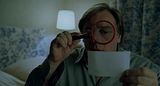
 shielding the room from the worst of the heat. Adam Ousmane sits across the wooden desk from Mme Wang, who is attended by her secretary. Silence, except for the faint sound of a pen scratching on paper. The office belongs to the new manager of the hotel in which Adam is employed as head pool attendant. ‘How old are you Adam?’ … ‘I often see you sitting in your chair?’ … ‘Do you really think we need two employees?’ Mme Wang makes further notes as Adam responds. Director Mahamat-Saleh Haroun’s camera lingers within these silences. Camera movement is discreet, reduced to a bare minimum, medium shots predominate and editing only occurs when absolutely necessary for a reframing. Colour is natural, the mise-en-scène sparse and diegetic sound prevails. The actors are restrained, sotto voce, gesture minimalised. Such procedures accentuate the everydayness of the film, but also inspire a subtle beauty in the image. At night, a long take of Adam on his motorbike, its lights illuminating the white walls of an alleyway, is breath-taking. Adam stands at a window of his house, sunshine plays upon his naked torso, the curtains are slowly allowed to fall back into place and enshadow him as he distances himself from what is happening outside. This cinematic asceticism has an immediate correlate with another procedure, one which transforms the simple into something far more complex. Missing moments: critical instants are effaced from the narration and do not appear on-screen. Such ellipses are an essential function of the story, of the narrative. Not in the sense that they are hidden so as to create mystery, and thus be recuperated, ultimately revealed, reclaimed in order to explain. Rather, these omissions are withheld to echo what another character could not know. These missing moments may be obvious (a cut in the middle of an important scene) or obscure (we may only realise later that something has been withheld). More significantly – such moments mirror what the character wishes to hide: their deceptions, disloyalties, dishonesty. Their shame, what they would not want others to know, the full import of their actions, words, silences. Character motivations are ambiguous, for others, for themselves and for the spectator. And Haroun ensures such ellipses are never revealed, ever sustained.
In this way – through the directness of the image and the complexity of ellipses – A Screaming Man creates a powerful image of everydayness, of the quotidian...
To read the full exploration of A Screaming Man through the Deleuze's sign of the 'quotidian,' see Deleuze's Cinema Books: Three Introductions to the Taxonomy of Images...